

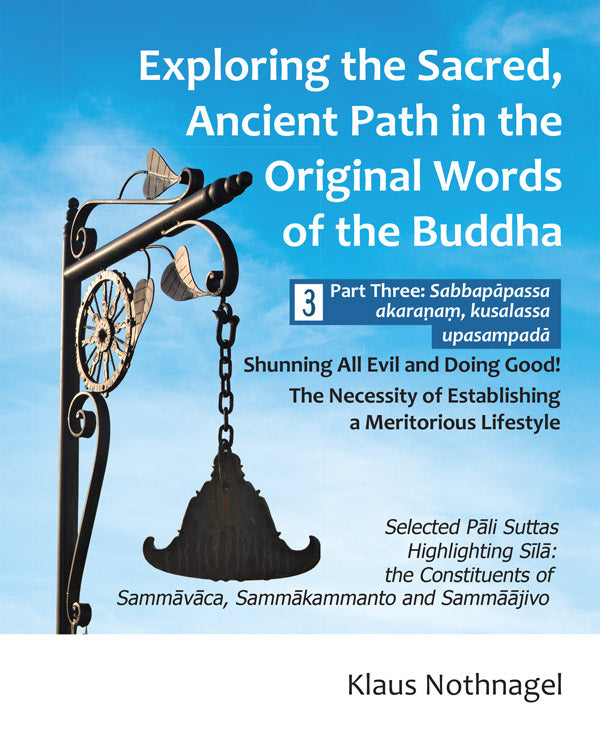
Exploring the Sacred, Ancient Path in the Original Words of the Buddha - Part Three: Sabbapāpassa akaraṇaṃ, kusalassa upasampadā (Pariyatti Edition)
Wholesale customers only.
Please log in to order from Pariyatti.
Buy Print

Downloads
Free DownloadAuthor: Nothnagel, Klaus
Publisher: Pariyatti Publishing
Publication Date: 2023-12-15
Product Type: paperback, PDF eBook
Pages: 530
ISBN 13: ISBN: 978-1-68172-870-4 (paperback), 978-1-68172-871-1 (PDF)
ISBN 10:
Language: English
SKU:
SKU:AMZNKDP778704
Description
Description
This collection, entitled Exploring the Sacred, Ancient Path in the Original Words of the Buddha (Exploring the Path or ETP), offers readers and followers of the Buddha's teaching a comprehensive survey and a practical resource for applying these ancient truths to daily life. While the series serves as a Pāli study program, those who wish to focus solely on the English translations and commentary will find profound clarification and inspiration for their journey.
Part One of this collection highlights the good fortune of living in a period where the Dhamma is available in both theory (pariyatti) and practice (paṭipatti) while Part Two initiates a deep dive into the Noble Eightfold Path (ariyo aṭṭhaṅgiko maggo) starting with right view (Sammā diṭṭhi) and right thought (Sammā saṅkappo).
Part Three, Shunning All Evil and Doing Good! - The Necessity of Establishing a Meritorious Lifestyle, continues to underscore the essential role of ethical conduct (sīla) as the foundation for spiritual progress on the path. The chosen texts focus on the basic principles of the three components of moral conduct, right speech (sammā vācā), right action (sammā kammanto) and right livelihood(sammā-ājīvo). Sammā vācā, noble, right speech primarily defined as absence of false, divisive, harsh, and frivolous speech is grounded in truthfulness, empathy, and kindness. It embraces justice and sincerity, and is filled with a genuine attitude of sympathetic feeling towards others. Sammā kammanto, right action, refers to actions that avoid harmful effects and generate beneficial outcomes for one and others. It is built on the profound realization that just as a person cherishes their own life and health, so do all other beings. Based on such comprehension, one abandons harmful actions and fosters sympathetic support. Likewise, in regards to sammā-ājīvo right, wholesome, upright livelihood the same reflection helps to maintain an attitude of honesty, righteousness, and empathy ensuring one's occupation and livelihood remain virtuous. The selected suttas along with their English translation and introductions allow deeper discernment into these moral factors, their consequences and depict principles that help to adopt them properly.
Key Features of Part Three:
- Right speech (sammā vācā): Defined as the absence of false, divisive, harsh, or frivolous talk, this factor is rooted in truthfulness, empathy, and kindness. It fosters a genuine attitude of sincerity and sympathetic concern for others.
- Right action (sammā kammanto): This involves choosing behaviors that avoid harm and generate benefit for oneself and others. It is built on the profound realization that just as one cherish one's own life and health, so do all other beings. This comprehension naturally leads one to abandon harmful activities in favor of supportive, compassionate ones.
- Right livelihood (sammā-ājīvo): By applying these same reflections to one's career, a student maintains an attitude of honesty and righteousness, ensuring their occupation remains virtuous and upright.
- Daily-life integration: Selected suttas, accompanied by English translations and insightful introductions, provide a deeper discernment into these moral factors, their consequences and the principles needed to integrate them into daily life.
Exploring the Path as a course represents a collection of Pāli lessons that are brought to life in "bite-sized" sections with custom glossaries that allow a new student to quickly absorb some of the most valuable teachings of the Buddha right from the beginning of the course. The approach to learning is one driven by a student s desire to understand the underlying content.
Initially planned as a simple handout of selected suttas for participants of a Pāli workshop, it turned into an online Pāli Learning Program with vocabulary tools, audio for pronunciation and introductions to each sutta. Each lesson is presented with a short summary, an introduction highlighting the context of the sutta with references to the Tipiṭaka, the commentaries, the historical background, and quotes offering a deeper understanding of the respective content as well as Pāli and English presented side-by-side with selective vocabulary
Rather than approaching the Pāli language with a list of vocabulary and linguistic rules, the lessons use custom glossaries to ease the student into the more complex tasks. The learning then comes from familiarity rather than memorization. The course aims to keep the student motivated through the unfolding of these ancient texts; learning the language becomes a natural by-product of the process. It also intends to stir a student to further self-study by referring to the complete suttas via online resources, aiding one to become more familiar with the Tipiṭaka.
A concise Introduction and Guide to Pāli Pronunciation and Grammar can be found in the first book, Part One: Dullabho, offering a convenient tool to look up Pāli syntax, declensions or conjugations whenever needed. Most lessons are expected to take a Pāli student somewhere between 20 and 45 minutes to complete. These lessons are intended to be sufficient keeping a student engaged, but not so overwhelming that they can't fit into an already busy schedule, even so to maintain their original spirit, some lessons include longer passages than others. Some suttas are divided into more parts and presented in different sub-chapters according to the provided contents. Each lesson is introduced with a short summary, an Introduction, and Pāli and English presented side-by-side with selective vocabulary. The student is encouraged additionally to refer to one of the various Pāli dictionaries for further references. Someone who prefers to read the Pāli directly without the English translation, undergo some vocabulary training and listen to the audio recordings may refer to the online version.
Endorsements
If you wish to receive the Buddha's teaching in his own words, or as close to them as possible; if you had a taste of Pāli, found it sweet and want some more this book may be a real gift for you. While providing all the essential basic linguistic knowledge, it soon delves into the heart of the teaching, thus offering a bridge of inspiration to help students cross the hurdles of learning an ancient language. Taking these short lessons, you'll find that you are learning what the Buddha taught while learning Pāli, and learning Pāli while learning what the Buddha taught.
In my years of research and, most importantly, of practicing Vipassana, I found it helpful not to be entirely dependent on translations. Learning even a little bit of Pāli removes some of the buffers and assists in getting more of the meaning and message. And getting more of the message supports walking the path. I've also found it best to learn the theory from those who truly practice. I don't think that it is possible to thoroughly understand the depths and subtleties of the Buddha's words without continuously trying to actualize them. For me, the author of this book is therefore ideal to learn from: his life-long practice of the path joins the knowledge of the ancient language to support a deep understanding of the teaching.
Michal Barnea-Astrog (PhD), author of Carved by Experience (Karnac, 2017), Psychoanalytic and Buddhist Reflections on Gentleness (Routledge, 2019) and other books
Klaus Nothnagel has done tremendous work with this series of books. I have no hesitation in recommending these books for anyone interested in learning Pali.
In 1963 Professor A.K. Warder wrote in his Introduction to Pali, "Rather than add another volume to the bewildering mass of books on 'Buddhism', it seems more constructive to open a door directly on the Pali." This still holds true today. Klaus Nothnagel has certainly opened a door on the Pali, with selections from a vast range of interesting and instructive discourses of the Buddha and comprehensive guides to the language used.
Sean Salkin, Pāli teacher
Klaus Nothnagel's new Pali study series is an amazing tool for studying Pali through the Buddha's teachings. I am so impressed by the tremendous effort he has put into it and its completeness. I highly recommend it!
William Crecelius, author of A Meditator's Handbook
Goenkaji always encouraged pariyatti (the theoretical study of Dhamma) as an important adjunct to paṭipatti (our practice). Now with this new Pali series, Klaus Nothnagel has cleverly combined lessons in Pali with key excerpts from the Buddha's teachings. The result is both revealing and inspirational and an invaluable companion for serious students of Vipassana.
Patrick Given-Wilson, producer of the Lineage Talks
A masterfully crafted book that summarizes the Pali language in all its depth, yet in a way that makes it accessible to non-academic students of the Dhamma. Just as the on-line and in-person courses that Klaus has developed, it paves the way for a deeper personal understanding of the Buddha's teachings in an inspiring way!
Jeff Glenn, Linguistics Scholar and Vipassana Practitioner
You now have in your hands this long-anticipated, well-tested, and thorough guide to the preserved teaching of the Buddha. May you make good use and achieve your aspirations.
Rick Crutcher, Treasurer, Vipassana Community Foundation
Read more about Klaus Nothnagel and the making of his Pāli course Exploring the Sacred, Ancient Path in the Original Words of the Buddha.
Watch the interview with Klaus Nothnagel about 'Exploring the Path'.
VIPASSANA PRODUCTS
Vipassana, which means to see things as they really are, is one of India's most ancient techniques of meditation. More information about Vipassana as taught by S.N. Goenka is available at www.dhamma.org.
The tag Vipassana identifies products that are directly related to this tradition and differentiates them from other Theravada resources available on our site. While the main emphasis in Vipassana meditation as taught by S.N. Goenka is on actual practice, this product may provide inspiration and guidance to a Vipassana meditator.
We also carry titles from the Theravada tradition, as we feel that by exploring the wider world of the Theravada texts, which include the Buddha’s discourses, commentaries, and scholarly articles and treatises, meditators have an opportunity to deepen their understanding of the Dhamma and thereby enrich their meditation practice. This kind of intellectual exploration also helps a meditator to gain an understanding of the evolution and historical context of their meditation tradition. This understanding in turn deepens their practice and understanding of the Dhamma.
Disclosure: Pariyatti is a participant in the Amazon Services LLC Associates Program, an affiliate advertising program designed to provide a means for sites to earn advertising fees by advertising and linking to Amazon.com.
Q: Why have you decided to partner with Amazon for the printing and distribution of your books?
A: Pariyatti is a non-profit organization whose purpose is to help disseminate the words of the Buddha.
The generosity of our customers and donors (donations make up ~25% of our revenue) is what has allowed Pariyatti to cover our annual shortfall, and permitted us to continue operations. We strive to continue to find ways to make best use of this hard-earned money, generously donated by so many to Pariyatti. One of these is to explore ways to optimize our operations.
Our goal is to disseminate Dhamma content. The choice of working with a given distribution partner is solely based on whether they can provide you, our customer (no matter where you live) with the item(s) you ordered in an accurate, timely, and reliable manner.
With the advent of eBooks and the internet, the entire book publishing and distribution industry has faced significant challenges. With these industry changes, and Pariyatti's additional challenges in serving a niche market with low sales volumes, it has been financially difficult to staff our own warehouse and operations. Year after year, the costs of maintaining our own warehouse has far exceeded the income.
By focusing on what we do best (such as make Dhamma content available at low or no cost), and partnering with others who have already built robust printing, packing, and delivery systems, we free up resources that can be redirected towards expanding Pariyatti's offerings for you.
We are always on the lookout for creative ways to make Dhamma content as widely and freely available as possible. If you have any ideas along these lines, please feel free to be in touch via director@pariyatti.org .