

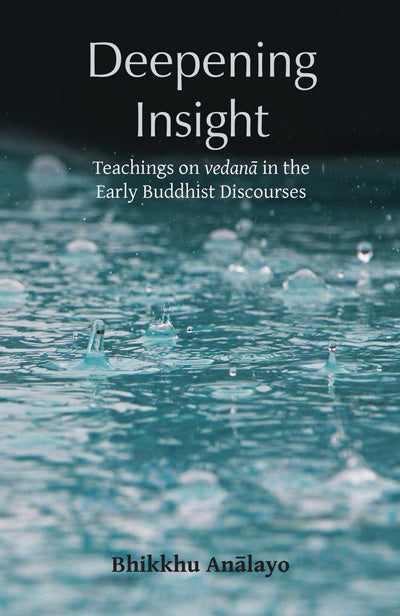
Deepening Insight by Bhikkhu Anālayo
Wholesale customers only.
Please log in to order from Pariyatti.
Buy Print

Buy eBook


Downloads
Free DownloadAuthor: Analayo, Bhikkhu
Publisher: Pariyatti Press
Publication Date: 2011-01-01
Product Type: book, eBook
Pages: 118
ISBN 13: 978-1-68172-403-4 (Print), 978-1-68172-404-1 (PDF), 978-1-68172-405-8 (ePub), 978-1-68172-406-5 (Mobi)
ISBN 10:
Language: English
SKU:
SKU:AMZNKDP774034
Description
Description
Click Google Preview button to look inside the book.
Deepening Insight presents a selection of passages from the early Buddhist discourses that provide perspectives on the cultivation of liberating insight into vedanā, sensation, feeling, or feeling tone. For meditators, such passages can be of considerable help as a reference point for deepening insight.
A metaphor that can offer considerable help when facing vedanās describes bubbles arising on the surface of a pond during rain...they arise and soon enough burst and disappear. Contemplation of the changing nature of vedanā provides a firm foundation for the growth of insight into not self. Such insight proceeds through successive layers of the mind's ingrained habit of self-referentiality. Based on relinquishing the explicit view of affirming the existence of a permanent self, increasingly subtler traces of conceit and possessiveness need to be successively overcome until with full awakening all selfing in any form will be removed for good.
Deepening Insight is based on textual sources that reflect "early Buddhism," which stands for the development of thought and practices during roughly the first two centuries in the history of Buddhism, from about the fifth to the third century BCE. These sources are the Pāli discourses and their parallels, mostly extant in Chinese translation, which go back to instructions and teachings given orally by the Buddha and his disciples. In those times in India, writing was not employed for such purposes, and for centuries these teachings were transmitted orally. The final results of such oral transmission are available to us nowadays in the form of written texts. Bhikkhu Anālayo's presentation is meant to provide direct access, through the medium of translation, to the Chinese gama parallels to relevant Pāli discourses. In commenting on such passages, his chief concern throughout is to bring out practical aspects that are relevant to actual insight meditation.
Endorsements
In spring 1990 S.N. Goenka initiated an international seminar named The Importance of Vedanā and Sampajañña. It had the purpose to disseminate the prominence of sensations (vedanā) as a core object of meditation to recognize the intrinsic nature of change and impermanence.
Venerable Bhikkhu Anālayo now provides a thorough, comprehensive and well selected collection on vedanā as maintained in the original early Pāli Canon. Along with the comparison to the Chinese gama, otherwise hardly available, this collection if adapted and applied to practice may indeed serve as an inspiring source for deepening insight.
—Klaus Nothnagel, Pāli teacher and Center Teacher for Dhamma Pallava in Poland
View the interview and questions-and-answers session with Bhikkhu Anālayo.
Note: to view Vimeo chapter markers on small screens, you may have to turn your screen to landscape position.
VIPASSANA PRODUCTS
Vipassana, which means to see things as they really are, is one of India's most ancient techniques of meditation. More information about Vipassana as taught by S.N. Goenka is available at www.dhamma.org.
The tag Vipassana identifies products that are directly related to this tradition and differentiates them from other Theravada resources available on our site. While the main emphasis in Vipassana meditation as taught by S.N. Goenka is on actual practice, this product may provide inspiration and guidance to a Vipassana meditator.
We also carry titles from the Theravada tradition, as we feel that by exploring the wider world of the Theravada texts, which include the Buddha’s discourses, commentaries, and scholarly articles and treatises, meditators have an opportunity to deepen their understanding of the Dhamma and thereby enrich their meditation practice. This kind of intellectual exploration also helps a meditator to gain an understanding of the evolution and historical context of their meditation tradition. This understanding in turn deepens their practice and understanding of the Dhamma.
Disclosure: Pariyatti is a participant in the Amazon Services LLC Associates Program, an affiliate advertising program designed to provide a means for sites to earn advertising fees by advertising and linking to Amazon.com.
Q: Why have you decided to partner with Amazon for the printing and distribution of your books?
A: Pariyatti is a non-profit organization whose purpose is to help disseminate the words of the Buddha.
The generosity of our customers and donors (donations make up ~25% of our revenue) is what has allowed Pariyatti to cover our annual shortfall, and permitted us to continue operations. We strive to continue to find ways to make best use of this hard-earned money, generously donated by so many to Pariyatti. One of these is to explore ways to optimize our operations.
Our goal is to disseminate Dhamma content. The choice of working with a given distribution partner is solely based on whether they can provide you, our customer (no matter where you live) with the item(s) you ordered in an accurate, timely, and reliable manner.
With the advent of eBooks and the internet, the entire book publishing and distribution industry has faced significant challenges. With these industry changes, and Pariyatti's additional challenges in serving a niche market with low sales volumes, it has been financially difficult to staff our own warehouse and operations. Year after year, the costs of maintaining our own warehouse has far exceeded the income.
By focusing on what we do best (such as make Dhamma content available at low or no cost), and partnering with others who have already built robust printing, packing, and delivery systems, we free up resources that can be redirected towards expanding Pariyatti's offerings for you.
We are always on the lookout for creative ways to make Dhamma content as widely and freely available as possible. If you have any ideas along these lines, please feel free to be in touch via director@pariyatti.org .