

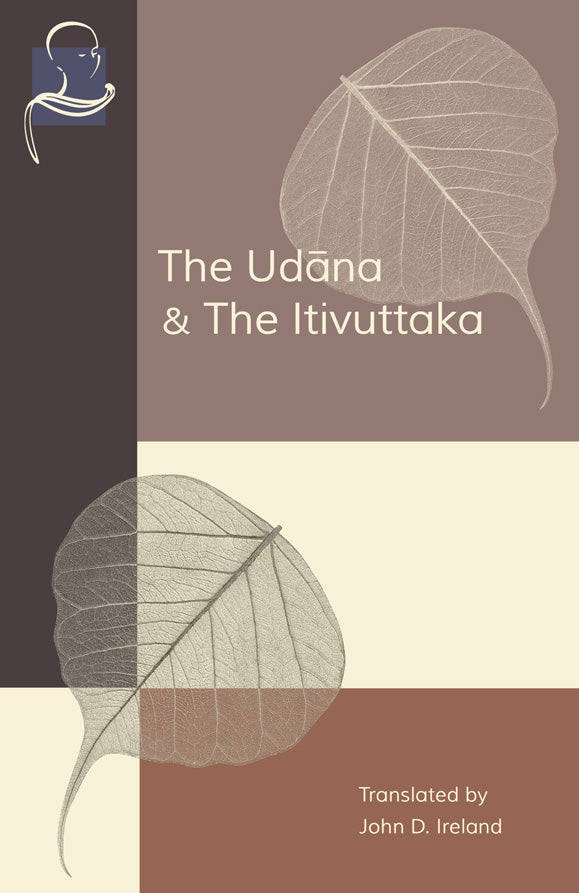
The Udana & The Itivuttaka (Pariyatti Edition)
Wholesale customers only.
Please log in to order from Pariyatti.
Buy Print

Buy eBook


Downloads
Free DownloadAuthor: Ireland, John D.
Publisher: Buddhist Publication Society
Publication Date: 2018-03-01
Product Type: Softcover Book
Pages: 246
ISBN 13: 978-1-68172-112-5 (print)
ISBN 10:
Language:
SKU:
SKU:AMZNKDP778720
Description
Description
Click Google Preview button to look inside the book.
Two short classics of the Pali Canon in one volume.
The Udana, or Inspired Utterances of the Buddha, belongs to the Sutta Pi aka of the Pali Canon. It is the third book of the Minor Collection (Khuddaka Nikaya), found between the Dhammapada and the Itivuttaka. The Minor (or Lesser) Collection, although it is actually quite bulky, is given this name because it is an assortment of miscellaneous texts most of which were not included in what are regarded as the four main collections (nikaya).
The Udana consists of eighty discourses, mostly short, divided into eight sections or chapters (vagga). The title Udana refers to the pronouncement, usually in verse, made at the end of each discourse and prefaced by the words: Then, on realizing its significance, the Lord uttered on that occasion this inspired utterance . Thus udana means an inspired or solemn utterance spontaneously evoked, literally breathed forth (udanesi), by the understanding or realization (viditva) of the significance of the situation or event that occasioned it. Here it is the Buddha who pronounces these utterances although others are sometimes so inspired (e.g., in 2.10 and 3.7).
The Itivuttaka is a collection of 112 short discourses of the Buddha in both prose and verse. The text belongs to the Pali Canon of the Therav da school, being placed between the Ud na and the Sutta Nip ta. It was previously translated by F.L. Woodward and published together with his translation of the Ud na in Minor Anthologies of the Pali Canon, Vol. II (London, 1935).
According to the commentarial tradition, the suttas or discourses of the Itivuttaka were collected by the woman lay-disciple Khujjuttar from sermons given by the Buddha while he was staying at Kosamb . Khujjuttar was a servant of S m vat , the consort of King Udena. She had become a stream-enterer after meeting the Buddha and subsequently converted the women of the palace headed by Samavatī to the teaching. She used to go regularly to listen to the Buddha and then later repeated what she had heard to the other women. The collection of these sayings became the Itivuttaka. It is said that the emphatic statements at the beginning and end of each of the suttas, reproduced here only in the first and last, were made by Khujjuttar to stress that they were the Buddha s words and not her own.
Whether or not this story is true, the Itivuttaka is the only book in the Pali Canon that introduces and concludes its suttas in this fashion, and it is from the opening statement that the title is derived: This was said (vuttaṃ) by the Lord so (iti) I heard hence Itivuttaka, The So-was-said or Sayings.
VIPASSANA PRODUCTS
Vipassana, which means to see things as they really are, is one of India's most ancient techniques of meditation. More information about Vipassana as taught by S.N. Goenka is available at www.dhamma.org.
The tag Vipassana identifies products that are directly related to this tradition and differentiates them from other Theravada resources available on our site. While the main emphasis in Vipassana meditation as taught by S.N. Goenka is on actual practice, this product may provide inspiration and guidance to a Vipassana meditator.
We also carry titles from the Theravada tradition, as we feel that by exploring the wider world of the Theravada texts, which include the Buddha’s discourses, commentaries, and scholarly articles and treatises, meditators have an opportunity to deepen their understanding of the Dhamma and thereby enrich their meditation practice. This kind of intellectual exploration also helps a meditator to gain an understanding of the evolution and historical context of their meditation tradition. This understanding in turn deepens their practice and understanding of the Dhamma.
Disclosure: Pariyatti is a participant in the Amazon Services LLC Associates Program, an affiliate advertising program designed to provide a means for sites to earn advertising fees by advertising and linking to Amazon.com.
Q: Why have you decided to partner with Amazon for the printing and distribution of your books?
A: Pariyatti is a non-profit organization whose purpose is to help disseminate the words of the Buddha.
The generosity of our customers and donors (donations make up ~25% of our revenue) is what has allowed Pariyatti to cover our annual shortfall, and permitted us to continue operations. We strive to continue to find ways to make best use of this hard-earned money, generously donated by so many to Pariyatti. One of these is to explore ways to optimize our operations.
Our goal is to disseminate Dhamma content. The choice of working with a given distribution partner is solely based on whether they can provide you, our customer (no matter where you live) with the item(s) you ordered in an accurate, timely, and reliable manner.
With the advent of eBooks and the internet, the entire book publishing and distribution industry has faced significant challenges. With these industry changes, and Pariyatti's additional challenges in serving a niche market with low sales volumes, it has been financially difficult to staff our own warehouse and operations. Year after year, the costs of maintaining our own warehouse has far exceeded the income.
By focusing on what we do best (such as make Dhamma content available at low or no cost), and partnering with others who have already built robust printing, packing, and delivery systems, we free up resources that can be redirected towards expanding Pariyatti's offerings for you.
We are always on the lookout for creative ways to make Dhamma content as widely and freely available as possible. If you have any ideas along these lines, please feel free to be in touch via director@pariyatti.org .