

Description
Description
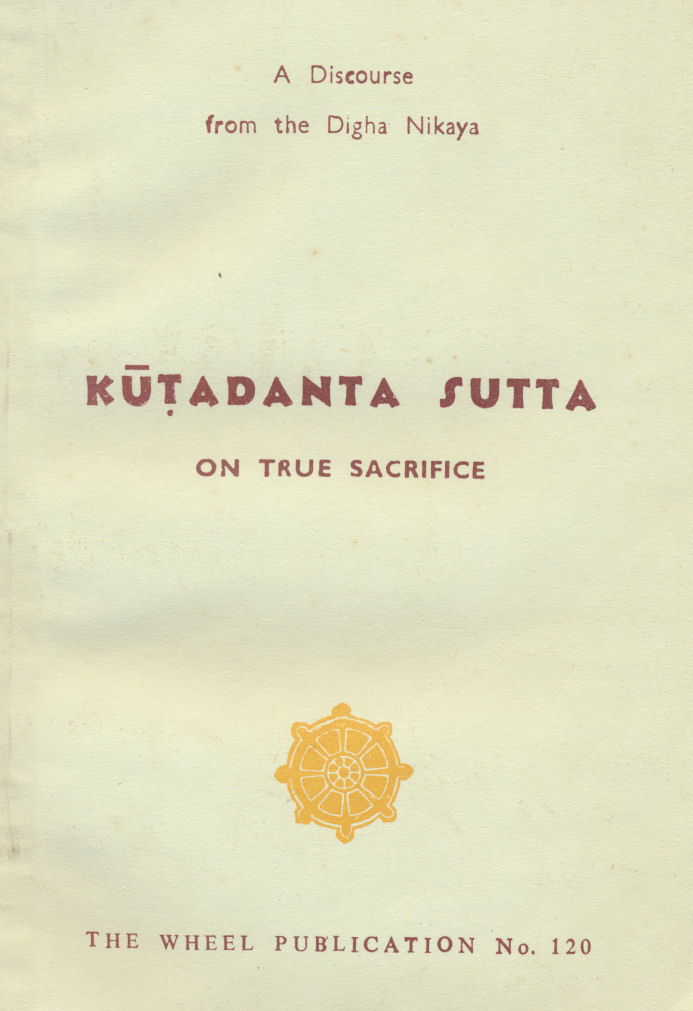
On the eve of offering a great sacrificial feast, the brahmin Kutadanta went to see the Buddha for advice on how best to conduct the sacrifice. Giving the example of a former King Mahavijita, who also made a great sacrificial offering, the Buddha declared the principle of consent by four parties from the provinces, namely, noblemen, ministers, rich brahmins and house holders; the eight qualities to be possessed by the king who would make the offerings; the four qualities of the brahmin royal adviser who would conduct the ceremonies and the three attitudes of mind towards the sacrifices. With all these conditions fulfilled, the feast offered by the king was a great success, with no loss of life of sacrificial animals, no hardship on the people, no one impressed into service, every one co-operating in the great feast willingly. The brahmin Kutadanta then asked the Buddha if there was any sacrifice which could be made with less trouble and exertion, yet producing more fruitful result. The Buddha told him of the traditional practice of offering the four requisites to bhikkhus of high morality. Less troublesome and more profitable again was donating a monastery to the Order of Bhikkhus. Better still were the following practices in ascending order of beneficial effects. (i) Going to the Buddha, the Dhamma, and the Samgha for refuge; (ii) observance of the Five Precepts; (iii) going forth from the homelife and leading the holy life, becoming established in morality, accomplished in the four jhanas, and equipped with eight kinds of higher knowledge resulting in the realization of extinction of asavas, the sacrifice which entails less trouble and exertion but which excels all other sacrifices.
Between 1958 and 2002, a total of 334 individual physical Wheel Publication booklets were published by the Buddhist Publication Society (BPS). Those 334 booklets included 468 essays, tracts, and monographs; many were published as double or triple volumes.
These classic Wheel booklets are not being reprinted; many are no longer available as single issues. We have the last print run in stock—the last existing physical booklets! If this specific Wheel No. is out of stock, please note that it won’t be restocked.
See also: Collected Wheel Publications series (BPE)—Pariyatti Edition (Free PDF available per volume)
Free PDF copies of individual booklets are available from the BPS website; some are listed, while others can be found via the Google search feature.
VIPASSANA PRODUCTS
Vipassana, which means to see things as they really are, is one of India's most ancient techniques of meditation. More information about Vipassana as taught by S.N. Goenka is available at www.dhamma.org.
The tag Vipassana identifies products that are directly related to this tradition and differentiates them from other Theravada resources available on our site. While the main emphasis in Vipassana meditation as taught by S.N. Goenka is on actual practice, this product may provide inspiration and guidance to a Vipassana meditator.
We also carry titles from the Theravada tradition, as we feel that by exploring the wider world of the Theravada texts, which include the Buddha’s discourses, commentaries, and scholarly articles and treatises, meditators have an opportunity to deepen their understanding of the Dhamma and thereby enrich their meditation practice. This kind of intellectual exploration also helps a meditator to gain an understanding of the evolution and historical context of their meditation tradition. This understanding in turn deepens their practice and understanding of the Dhamma.
Disclosure: Pariyatti is a participant in the Amazon Services LLC Associates Program, an affiliate advertising program designed to provide a means for sites to earn advertising fees by advertising and linking to Amazon.com.
Q: Why have you decided to partner with Amazon for the printing and distribution of your books?
A: Pariyatti is a non-profit organization whose purpose is to help disseminate the words of the Buddha.
The generosity of our customers and donors (donations make up ~25% of our revenue) is what has allowed Pariyatti to cover our annual shortfall, and permitted us to continue operations. We strive to continue to find ways to make best use of this hard-earned money, generously donated by so many to Pariyatti. One of these is to explore ways to optimize our operations.
Our goal is to disseminate Dhamma content. The choice of working with a given distribution partner is solely based on whether they can provide you, our customer (no matter where you live) with the item(s) you ordered in an accurate, timely, and reliable manner.
With the advent of eBooks and the internet, the entire book publishing and distribution industry has faced significant challenges. With these industry changes, and Pariyatti's additional challenges in serving a niche market with low sales volumes, it has been financially difficult to staff our own warehouse and operations. Year after year, the costs of maintaining our own warehouse has far exceeded the income.
By focusing on what we do best (such as make Dhamma content available at low or no cost), and partnering with others who have already built robust printing, packing, and delivery systems, we free up resources that can be redirected towards expanding Pariyatti's offerings for you.
We are always on the lookout for creative ways to make Dhamma content as widely and freely available as possible. If you have any ideas along these lines, please feel free to be in touch via director@pariyatti.org .