

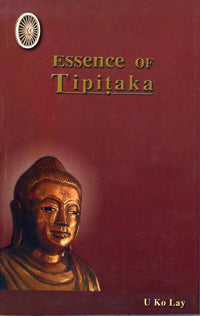
Essence of Tipitaka
Wholesale customers only.
Please log in to order from Pariyatti.
Buy Print

Buy eBook

Downloads
Free DownloadAuthor: Lay, U Ko
Publisher: Vipassana Research Institute
Publication Date: 1998-01-01
Product Type: Softcover Book
Pages: 221
ISBN 13: 978-81-7414-021-0
ISBN 10: 8174140212
Language:
SKU:
SKU:140212
Description
Description
This book is a good introduction to understanding the parts, structure, and meanings of the Tipiṭaka. Tipiṭaka is the Pāli word meaning "Three Baskets" used to describe the body of discourses and teachings (in three categories) credited to Siddhartha Gotama, or the historical Buddha. It is also called the Pāli Canon. Specialized monks memorized his stories and discourses for centuries before coming together to put them into one body of work.
A descriptive overview is given for each section, or "basket" of the Tipiṭaka, including the Vinaya Piṭaka (code of disciplinary rules for monks and nuns), Abhidhamma Piṭaka (collection of philosophical treatises), and the Sutta Piṭaka (Buddha's discourses).
The author of this concise guide to the Tipiṭaka is U Ko Lay, formerly the Vice-Chancellor of Mandalay University and a devoted student of Sayagyi U Ba Khin.
VIPASSANA PRODUCTS
Vipassana, which means to see things as they really are, is one of India's most ancient techniques of meditation. More information about Vipassana as taught by S.N. Goenka is available at www.dhamma.org.
The tag Vipassana identifies products that are directly related to this tradition and differentiates them from other Theravada resources available on our site. While the main emphasis in Vipassana meditation as taught by S.N. Goenka is on actual practice, this product may provide inspiration and guidance to a Vipassana meditator.
We also carry titles from the Theravada tradition, as we feel that by exploring the wider world of the Theravada texts, which include the Buddha’s discourses, commentaries, and scholarly articles and treatises, meditators have an opportunity to deepen their understanding of the Dhamma and thereby enrich their meditation practice. This kind of intellectual exploration also helps a meditator to gain an understanding of the evolution and historical context of their meditation tradition. This understanding in turn deepens their practice and understanding of the Dhamma.
Disclosure: Pariyatti is a participant in the Amazon Services LLC Associates Program, an affiliate advertising program designed to provide a means for sites to earn advertising fees by advertising and linking to Amazon.com.
Q: Why have you decided to partner with Amazon for the printing and distribution of your books?
A: Pariyatti is a non-profit organization whose purpose is to help disseminate the words of the Buddha.
The generosity of our customers and donors (donations make up ~25% of our revenue) is what has allowed Pariyatti to cover our annual shortfall, and permitted us to continue operations. We strive to continue to find ways to make best use of this hard-earned money, generously donated by so many to Pariyatti. One of these is to explore ways to optimize our operations.
Our goal is to disseminate Dhamma content. The choice of working with a given distribution partner is solely based on whether they can provide you, our customer (no matter where you live) with the item(s) you ordered in an accurate, timely, and reliable manner.
With the advent of eBooks and the internet, the entire book publishing and distribution industry has faced significant challenges. With these industry changes, and Pariyatti's additional challenges in serving a niche market with low sales volumes, it has been financially difficult to staff our own warehouse and operations. Year after year, the costs of maintaining our own warehouse has far exceeded the income.
By focusing on what we do best (such as make Dhamma content available at low or no cost), and partnering with others who have already built robust printing, packing, and delivery systems, we free up resources that can be redirected towards expanding Pariyatti's offerings for you.
We are always on the lookout for creative ways to make Dhamma content as widely and freely available as possible. If you have any ideas along these lines, please feel free to be in touch via director@pariyatti.org .