

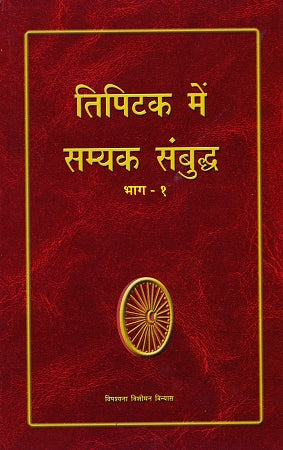
Tipitaka Mein Samyaka Sambuddha (Hindi) - Vol 1
Vipassana

This product is directly related to Vipassana meditation as taught by S.N. Goenka.
Author: Goenka, S.N.
Publisher: Vipassana Research Institute
Publication Date: 2011-01-01
Product Type: Softcover book
Pages: 110
ISBN 13: 978-81-7414-288-7
ISBN 10:
Language: Hindi
SKU:
SKU:140261
Description
Description
Tipitaka Mein Samyak Sambuddha, first published in two volumes, has been divided into six parts now for the convenience of the reader as well as the buyer.
In Volume 1 Goenkaji explains what pi aka actually means and when and why the Tipitaka was recited. Contrary to the views of others who interpret pitaka as 'basket', he interprets it as 'scripture' which is corroborated by the Buddha's use of the word in Kesamutti sutta and other suttas.
He has also brought out the physical beauty of the Buddha who had 32 marks of a great man and which attracted some of the disciples to him. But against this perishable physical body (rupa-kaya) he has also shown the imperishable Dhamma-kaya (teachings of the Buddha). Dhamma-k ya is not only imperishable and immortal but also infinite, deep and immeasurable like the sea. It is infinite because it is taught by one whose cravings that make one limited are rooted out in the same way as a palm tree is cut which can never grow again. In this part one of the nine qualities of the Buddha, that he is an arhat, has been explained with many examples culled from the Tipitaka.
In Volume 2 Goenkaji explains two other qualities of the Buddha with examples from the Sutta pitaka such as, he is Perfectly Enlightened and he is endowed with vijja (wisdom) and acarana (conduct).
In Volume 3 many more examples are given from the Tipitaka to bring out his great wisdom (vijja) and pure conduct (acarana). That he is sugata i.e. whose physical, vocal and mental actions are pure, faultless and not blameworthy has also been brought out here. The Pali quotations given here from the Tipi aka to illustrate these points have been translated into Hindi so that readers who do not know Pali can enjoy reading the book and understand what Goenkaji wants to say.
In Volume 4 Goenkaji explains the other three of the nine qualities of the Buddha. The Buddha is a lokavidu i.e. he is a knower of the world. In other words, he does not only know the world but he also knows how it comes into being, how one can transcend it and go beyond it and how it can be eliminated. Besides this, the Buddha is an incomparable charioteer and knows how to tame the people who are to be tamed just as a charioteer trains a horse of good breed. The Buddha trains people in such a way that not only their life becomes virtuous but also they do good to others who come in their contact. He chisels them in such a way that they become very useful for society besides being good for themselves. Goenkaji also explains how the Buddha is a teacher of gods and men and he does not teach them what he has heard from others, nor does he teach them what is irrefutable by logic, but instead he teaches them what he has himself experienced and, therefore, he is a different kind of teacher.
In Volume 5 Goenkaji continues to explain more of the Buddha s qualities as a teacher of gods and men. Then he explains why he is called the Buddha.
He is called the Buddha because he attained bodhi all by himself, without the help of any teacher and has become cool and quenched. He teaches people to observe noble silence so that they can practice meditation, remove defilements that cause their suffering from their minds, realize impermanence, suffering and no-self, develop non-attachment to all objects of the world and attain peace and happiness.
In Volume 6 Goenkaji provides further explanation as to why the term Buddha is appropriate. Then he explains why Buddha is called Bhagava. He is called Bhagava because he has destroyed all cravings (raga), all aversions (dosa) and all ignorance (moha). He has earned this name by dint of his own efforts. This name has not been given to him by his parents or other relatives.
The Buddha was a great man who thought good of all. He taught his Dhamma to all in such a way that they enjoyed listening to it and putting it into practice in their life.
He also had a sense of humor as is evident from what he said to Akkosaka Bharadvaja. All these aspects of his personality have been highlighted with apt quotations from the Tipi aka along with their Hindi translations.
Goenkaji has also brought out one important aspect of Dhamma. The Buddha says that Dhamma should be used just as a raft to cross the ocean of becoming and after crossing, it should not be carried by one on his shoulders. The meaning is that one should not develop attachment even to Dhamma.
In this way Goenkaji has highlighted the important aspects of the Buddha with examples he collected from a deep study of the Tipitaka.
All the six parts of the TSS contain Hindi word index, Pali word index, index of sutta, gatha and vatthu and index of proper names.
The way the parts of the Tipitaka Mein Samyak Sambuddha have been arranged and the quotations from the Tipi aka with their Hindi translations have been given make them a very interesting reading and one can know all important aspects of the personality of the Buddha and his Dhamma from them.
The Tipitaka Mein Samyak Sambuddha divided into six parts can well be said to be an ocean in a pot.
Professor Angraj Chaudhary
Sixth volume of the Introduction to the Tipitaka. Written in Hindi language.
"What distinguishes this presentation is Goenkaji's sparkling enthusiasm for spreading the message of the Buddha. This he does by most skillfully giving precise quotations of the words of the Buddha in response to the questions of his lay and mendicant followers. The entire work thus becomes a garland of flowers, to use a Buddhist metaphor, in the form of the Buddha's own great utterances. Goenkaji's eagerness to share his happiness in Vipassana and his insights into the sublime essence of Buddhism will inspire and uplift those who read this book. The Hindi-speaking world owes deep gratitude to the author for this lucid and enlightening introduction to the heart of Buddhism."
Dr. P. S. Jaini, Prof. of Buddhist Studies, U. of California at Berkeley
Find the other books in the series below in the "Related Items" section to Add to Cart.
VIPASSANA PRODUCTS
Vipassana, which means to see things as they really are, is one of India's most ancient techniques of meditation. More information about Vipassana as taught by S.N. Goenka is available at www.dhamma.org.
The tag Vipassana identifies products that are directly related to this tradition and differentiates them from other Theravada resources available on our site. While the main emphasis in Vipassana meditation as taught by S.N. Goenka is on actual practice, this product may provide inspiration and guidance to a Vipassana meditator.
We also carry titles from the Theravada tradition, as we feel that by exploring the wider world of the Theravada texts, which include the Buddha’s discourses, commentaries, and scholarly articles and treatises, meditators have an opportunity to deepen their understanding of the Dhamma and thereby enrich their meditation practice. This kind of intellectual exploration also helps a meditator to gain an understanding of the evolution and historical context of their meditation tradition. This understanding in turn deepens their practice and understanding of the Dhamma.
Disclosure: Pariyatti is a participant in the Amazon Services LLC Associates Program, an affiliate advertising program designed to provide a means for sites to earn advertising fees by advertising and linking to Amazon.com.
Q: Why have you decided to partner with Amazon for the printing and distribution of your books?
A: Pariyatti is a non-profit organization whose purpose is to help disseminate the words of the Buddha.
The generosity of our customers and donors (donations make up ~25% of our revenue) is what has allowed Pariyatti to cover our annual shortfall, and permitted us to continue operations. We strive to continue to find ways to make best use of this hard-earned money, generously donated by so many to Pariyatti. One of these is to explore ways to optimize our operations.
Our goal is to disseminate Dhamma content. The choice of working with a given distribution partner is solely based on whether they can provide you, our customer (no matter where you live) with the item(s) you ordered in an accurate, timely, and reliable manner.
With the advent of eBooks and the internet, the entire book publishing and distribution industry has faced significant challenges. With these industry changes, and Pariyatti's additional challenges in serving a niche market with low sales volumes, it has been financially difficult to staff our own warehouse and operations. Year after year, the costs of maintaining our own warehouse has far exceeded the income.
By focusing on what we do best (such as make Dhamma content available at low or no cost), and partnering with others who have already built robust printing, packing, and delivery systems, we free up resources that can be redirected towards expanding Pariyatti's offerings for you.
We are always on the lookout for creative ways to make Dhamma content as widely and freely available as possible. If you have any ideas along these lines, please feel free to be in touch via director@pariyatti.org .